8-8-8
Agata Madejska
8-8-8
Wernisaż 24.11.2025, godz. 19.00
Wystawa: 25.11-22.12.2025
Tekst: Emily Butler
Zrzucanie
SKÓRY
PAZNOKCI
WŁOSÓW
STAWÓW
MIĘŚNI
ENERGII
SNU
ZAMGLONEJ GŁOWY
Zwierzę czy glon…
Hello
Congratulations
This is for you
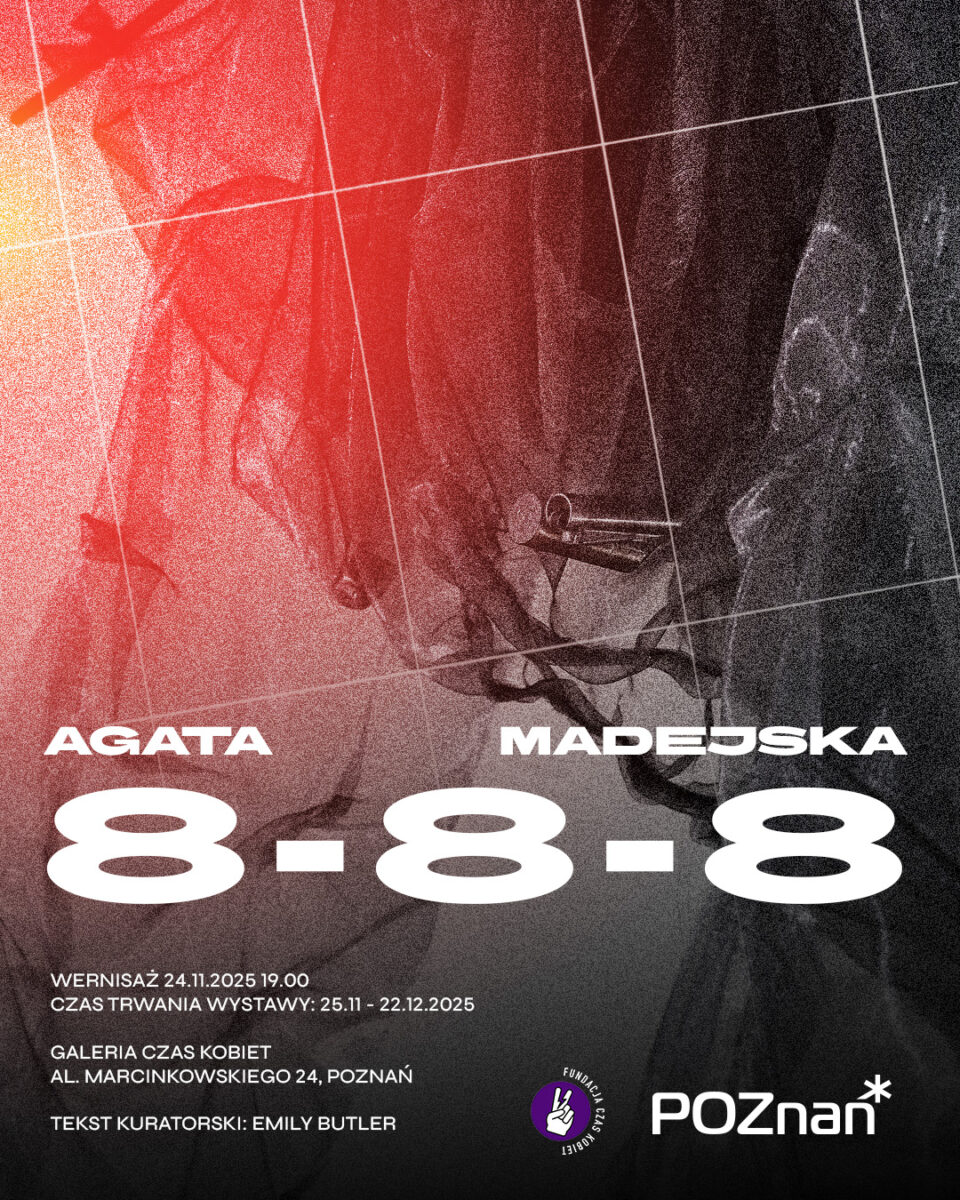
W przestrzeni zawieszona jest duża, półprzezroczysta skóra, starannie ustawiona tak, by można było objąć wzrokiem całą jej rozpiętość. Przypomina jednocześnie zrzucony pancerz skorupiaka, wylinkę gada i delikatny, jakby gazowy kombinezon ochronny — obcy, a jednak kruchy. Przy bliższym spojrzeniu widać na jej powierzchni wszyte kieszonki, skrywające osobliwe, lśniące przedmioty: monety, zapalniczkę, szklane kulki, grzebień do wyczesywania wszy. Brak głowy sugeruje, że to porzucona warstwa ochronna jakiejś monstrualnej istoty. A jednak fragmenty wewnętrznej struktury, jak wnętrzności, są nadal widoczne — jakby to, co ją opuściło, zostało nagle odsłonięte i podatne na zranienie.
Praca Agaty Madejskiej Housing T (Current Affairs) (2024) łączy te sprzeczności w delikatnej równowadze. Ucieleśnia superstruktury, w których artystka porusza się na co dzień — schronienie, normy społeczne — a równocześnie mieści w sobie drobne zasoby, które niesie dla innych: jako nauczycielka, rodzic, członkini rodziny. Te niewielkie elementy układają się w swoistą archeologię kieszeni jej i jej syna T, który porusza się wśród reguł i codziennych zdarzeń, tworząc własny system znaczeń, zanim również zostanie uformowany przez społeczne normy.
Zrzucona skóra wskazuje na cykliczność odpowiedzialności oraz na jej kruchość jako formy, która podlega ciągłemu zużyciu. Zawieszona w przestrzeni staje się chwilowym zawieszeniem przypisanych ról — momentem, w którym ciało mogłoby odzyskać autonomię i oddech od struktur społecznych oplatających je każdego dnia i powracających jak nieskończona pętla ósemki. Jednocześnie tytuł wystawy 8-8-8 przywołuje hasło Roberta Owena z 1817 roku, wzywające do równowagi między pracą, wypoczynkiem i czasem wolnym. Housing T wydobywa ochronne i ideologiczne warstwy, jakie wokół siebie budujemy, oraz ulotną ulgę, jaka pojawia się, gdy udaje nam się je na chwilę zrzucić.
Czasownik to shed ma bogatą etymologię: oznacza oddzielać, rozdzielać — jak podczas czesania włosów — a także „przelać” krew lub łzy. Jako rzeczownik, shed określa lekką, magazynową konstrukcję. W swoich precyzyjnych gestach i oszczędnych aranżacjach Madejska tworzy gramatykę form, która wynosi na powierzchnię to, co zwykle wypierane: płyny ciała, pasożyty, obcą materię, nienormatywne ciała… A jednocześnie odsłania niewidzialne struktury wiążące nas w tkance społecznej: mieszkanie, rodzinę, pracę, utrzymanie, bezpieczeństwo.
W tym czasie natrętny głos nieustannie dociera do nas z otoczenia.
Hello
Congratulations
Your attention is needed
W towarzyszącym wystawie pulsującym utworze dźwiękowym Hello, Congratulations (2024) Madejska splata ze sobą gratulacyjne wiadomości spamowe obiecujące luksus, piękno i spełnienie, lecz także „broń, technologię, statki, wille”, jak również alarmowe numery dotyczące zdrowia reprodukcyjnego. Przenikają się z nimi przetworzone wersy z poematu Bernarda Mandeville’a Bajka o pszczołach (1714), satyry badającej związek dobrobytu z moralnością, która sugeruje, że wolny rynek w istocie napędzany jest występkiem.
Wyrwane z kontekstu teksty ukazują podstępny splot kapitalizmu, retorycznego uwodzenia i interesowności. Podkreślając pokusę „oszukania systemu” poprzez korupcję i występek, artystka pokazuje, że ostatecznie wzmacnia to właśnie ten porządek, od którego próbuje się uciec. Jak symbol nieskończoności — wielokrotnie powtarzana ósemka w tytule wystawy — kapitalizm jawi się jako struktura bez wyjścia. Madejska przygląda się językowej i moralnej gramatyce współczesnych gospodarek, pytając, czy poczucie własnej wartości może naprawdę stać się narzędziem oporu.
Dźwięk oddziałuje na nasze zmysły niczym ścieżka ASMR: głęboki bas pulsuje jak serce, bura tekstura tonów szumi i drga, a głos artystki — echem, uporem i miękką stanowczością — prowadzi nas przez kolejne frazy. Grając na naszych oczekiwaniach wobec „kobiecej łagodności” czy usługowej gładkości bota, powtarzane „hello congratulations” stopniowo nabiera niepokojącej intensywności. Słowa przechodzą od kojącej obietnicy do odsłonięcia ciemnych stron kapitalizmu: „Keep it sly, Ready to screw”. Praktyka Madejskiej od dawna bada relację między językiem a władzą, śledząc niemal niewidzialne formy przymusu wplecione w rytm codzienności.
Hello
Congratulations
We are waiting for it to continue like this
Rehearsals and failures
Please take a quick look
W pracy Options (2025) artystka wykorzystuje zestaw jarzeniowych świetlówek, na których ledwie widoczne są imiona takie jak „Sophia”. To widmowe echo kontrowersyjnej brytyjskiej kampanii rekrutacyjnej z 2020 roku, promującej pracę w cyberbezpieczeństwie. Plakaty przedstawiały osoby o imionach Naomi, Dan, Jahmal, Fatima, Omar i Sophia — pracowników call center, kasjerów, baletnicę, fryzjera czy ekspedientkę vintage — których zawody potraktowano jako mniej wartościowe, zastępując je sloganem: „jej/jego następna praca może być w cyber (chociaż jeszcze o tym nie wie)”. Kampanię, wypuszczoną w czasie pandemicznych cięć w kulturze, szybko wycofano po fali krytyki. Madejska przywołuje tutaj jej widmowe pozostałości, zachęcając do uważnego spojrzenia na to, co zostało odrzucone lub wyciszone.
Razem te prace badają, jak przypisuje się wartość — ekonomiczną, społeczną i materialną. Madejska korzysta ze swojego wieloletniego zainteresowania semiotyką przedmiotów i obrazów oraz ich relacją z systemami władzy. Zastanawia się nad tym, co krąży na granicy widzialności: ulotne ślady materialne i dźwiękowe, strukturalne pozostałości. Jej prace dotyczą prekaryjnej pracy, niepewności mieszkaniowej, praw reprodukcyjnych oraz niewidocznej, niedocenianej pracy opiekuńczej i utrzymaniowej — często spoczywającej na kobietach. Przez całą wystawę artystka pyta, jak można zrzucić traumę i na jej miejsce tworzyć nowe struktury i nowe języki wsparcia.
Hello
Congratulations
How did we do?
Do we not owe the growth of wine
To the dry shabby crooked vine?
Offers and news
I hope you don’t mind
_____
Agata Madejska pracuje na styku procesów postfotograficznych, interwencji rzeźbiarskich, dźwięku i instalacji. Jej praktyka bada, jak kształtowane są osobiste i instytucjonalne formy władzy, jak rozdzielane są zasoby, a także jak splatają się ze sobą polityki domowe i państwowe.
W swoich najnowszych projektach artystka przygląda się różnym ideologiom wartości i własności – w odniesieniu do zasobów naturalnych i publicznych, mieszkalnictwa, infrastruktury, utowarowienia kobiecego ciała oraz szerzej pojętego ciała politycznego. Czerpiąc z własnej historii dorastania i migracji z postkomunistycznej Polski do Niemiec w 1992 roku, interesuje się momentami politycznego rozpadu, alternatywnymi modelami ekonomicznymi, projektami pilotażowymi i wszelkimi rodzajami symulacji, w których sukces i porażka pozostają jednakowo możliwe.
Agata Madejska jest profesorką (Art and Image | Photography, Institute for Fine Arts) na Akademii Sztuk Pięknych w Wiedniu. Wcześniej wykładała na University of Arts London oraz na Folkwang University of the Arts w Essen. Prowadziła także wykłady gościnne i spotkania artystyczne m.in. w Royal College of Art w Londynie, HfBK w Dreźnie, Royal Academy of Arts w Londynie, Courtauld Institute of Art, Sotheby’s Institute of Art, w Instytucie Historii Sztuki Uniwersytetu Ruhry w Bochum oraz w Kordegardzie – Narodowym Centrum Kultury w Warszawie.
Emily Butler jest niezależną kuratorką, pisarką i redaktorką. Prowadzi również badania doktorskie z zakresu kuratorstwa na University of Reading / OnCurating Academy w Berlinie, koncentrując się na tym, jak artyści i kuratorzy stają się (nie)tłumaczami, pracując coraz częściej ponad granicami, między językami, systemami znaków i kulturami. Jest kuratorką stowarzyszoną w Griffin Art Projects w Vancouver. Wcześniej pełniła funkcję dyrektorki programowej w Contemporary Arts Society w Vancouver, kuratorki Platform Talks podczas Art Toronto (2024) oraz kuratorki rozmów na Art Basel (2021–2023). W latach 2010–2022 była kuratorką w Whitechapel Gallery w Londynie. Pracowała także w dziale sztuk wizualnych British Council, w studiu Antony’ego Gormleya oraz w Centre Pompidou. Współpracuje z międzynarodowymi publikacjami i wykładała gościnnie na Emily Carr University, Royal College of Art, OnCurating Academy oraz London Metropolitan University
_____
Shedding
SKIN
NAILS
HAIR
JOINTS
MUSCLES
ENERGY
SLEEP
FOGGY HEAD
Animal or algae…
Hello
Congratulations
This is for you
A large translucent skin hangs in the space, carefully positioned so that its full breadth is visible. It appears at once like a cast-off crustacean shell, a reptile’s skin, and a gauze hazmat suit, strange, yet delicate. As you look closer, you notice pockets stitched into the surface containing curious, mostly silver objects: coins, a lighter, marbles, a lice comb. The figure has no head, which indicates it might be the protective layer shed by a monstruous figure. Yet, part of its internal structure or entrails are also visible, hinting that this creature may now be vulnerable.
Agata Madejska’s Housing T (Current Affairs) (2024) holds these contradictions in balance. It embodies the superstructures she navigates daily, such as shelter and social conformity,
while also containing the provisions she carries for others: as a teacher, parent or family member. The small items suggest an archaeology of hers and her son T’s pockets, who moves through rules and state of affairs, assembling his own system of value before he, too is inevitably socialised. The sloughed skin points towards the cyclical nature of responsibility, as well as its
expenditure as a fragile form. Hung up in the space, it offers a temporary suspension from prescribed roles, a moment in which the body might reclaim autonomy and respite from the
social structures that bind us daily and that loop endlessly like the figure eight. Conversely, the exhibition’s title 8-8-8 invokes Robert Owen’s 1817 call for a balanced rhythm of work,
recreation, and rest. Housing T visualises the protective and ideological layers we build up around us, and the fleeting relief of shedding them.
The verb shed carries a rich etymology: it means to separate, to divide, such as to comb hair, and to discharge blood or tears. As a noun, it means a light storage structure. In her precise gestures and minimal arrangements, Madejska offers a grammar of form that highlights the excesses that society keeps at bay: bodily fluids, pests, foreign matter, non-normative bodies… At the same time, she magnifies the invisible structures that connect
us within the fabric of society: housing, family, employment, subsistence, security. Meanwhile, an urgent, insistent voice calls out to us.
Hello
Congratulations
Your attention is needed
In the accompanying pulsing audio piece Hello, Congratulations (2024), Madejska melds together congratulatory spam messages promising dreams, luxury, and beauty, but also “guns, tech, ships, villas” along with urgent reproductive health-services numbers. These intermingle with abstracted lines from Bernard Mandeville’s poem The Fable of the Bees (1714), a satire on the relationship between prosperity and morality, which suggests that a successful free market is, rather, fuelled by vice. Plucked from their original context, the texts reveal the insidious tangle between capitalism, rhetorical seduction and self-interest. Here,
by highlighting an invitation to cheat the system, through corruption or vice, Madejska underlines how ultimately this reinforces the very system it claims to subvert. Like the
looping symbol of infinity – the number 8 repeated in her exhibition title – there seems to be no viable alternative to capitalism. Her inquiry explores the linguistic and moral grammar governing today’s economies, asking whether self-respect can in reality be weaponised.
The sound stimulates our senses like an ASMR track, its deep bass pulsing like a heartbeat, grey tones grating, modulated by Madejska’s own echoing yet insistent voice. Playing on our
expectations of female softness, or the serviceability of a bot, the repetition of “hello congratulations” becomes increasingly uncanny. The spoken words move from a soothing promise to magnifying the dark side of capitalism: “Keep it sly, Ready to screw”. Madejska’s practice has long explored the relationship between language and power, tracing the nearly invisible forces of coercion that permeate everyday life.
Hello
Congratulations
We are waiting for it to continue like this
Rehearsals and failures
Please take a quick look
Finally, Options (2025), are a group of fluorescent tubes featuring barely noticeable names
such as ‘Sophia’. They are ghostly reminders of a controversial UK government cyber-security recruitment campaign of 2020. Its posters presented characters including Naomi, Dan, Jahmal, Fatima, Omar and Sophia, whose lines of work (a call-centre operator, supermarket employees, a ballet dancer, a barber, and a vintage clothing shop assistant) were dismissed in favour of the slogan that his or her “next job could be in cyber (she just
doesn’t know it)”. Released at the height of pandemic-era cuts to the arts, the campaign was swiftly dropped after backlash about how these individuals’ activities were devalued through
it. Here, Madejska revives its spectral traces, inviting us to look carefully at what has been discarded or silenced.
Together, the bodies of work examine how value is assigned, economically, socially and materially. Madejska draws on her long-standing interest in the semiotics of objects and
images, and their relation to systems of power. She considers what circulates at the limits of legibility: faint, material and sonic traces, and structural residues. Her work addresses
worker precarity, housing insecurity, reproductive rights, and the invisible, undervalued nature of the labour of care and maintenance, often borne by women. Throughout the show
Madejska asks, how might one shed trauma and build new structures and languages of support instead?
Hello
Congratulations
How did we do?
Do we not owe the growth of wine
To the dry shabby crooked vine?
Offers and news
I hope you don’t mind
Agata Madejska
Agata Madejska works across post-photographic processes, sculptural interventions, sound and installation. Her work reflects on the articulation of both personal and institutional power, distribution of resources, and the interplay between domestic and state politics. In her recent projects she examines various ideologies of value and ownership in regard to natural and public resources, housing and infrastructures, the commodification of the female body, and the broader body politic. Informed by her personal history of growing up in and migrating from post-communist Poland to Germany in 1992, she is interested in moments of political disintegration, alternative economic models, pilot schemes, and all sorts of simulations
where success and failure remain equally possible. Agata Madejska is Univ.prof. (Art and Image | Photography, Institute for Fine Arts) at the Academy of Fine Arts in Vienna. She has
previously taught at the University of Arts London and at the Folkwang University of the Arts (Essen). She has given guest lectures and artist talks at the Royal College of Art (London),
HfBK Dresden, Royal Academy of Arts (London), the Courtauld Institute of Art (London), the Sotheby’s Institute of Art (London), the Institute of Art History at Ruhr University Bochum and Kordegarda – National Centre for Art (Warsaw).
https://www.madejska.eu
Emily Butler
Emily Butler is a freelance curator, writer and editor. She is also a PhD researcher in Curating at the University of Reading / OnCurating Academy, Berlin, on the topic of artists and curators as (mis)translators, as they work increasingly across borders, between languages, sign systems and cultures. She is Adjunct Curator at Griffin Art Projects Vancouver. Previously, she served as Head of Programmes at the Contemporary Arts Society in Vancouver, Platform Talks Curator at Art Toronto (2024), and Conversations Curator at Art Basel (2021–2023). From 2010 to
2022, she was a curator at Whitechapel Gallery in London. She has also held roles in the Visual Arts team at the British Council, Antony Gormley Studio, and the Centre Pompidou.
She contributes to international publications, and has been a visiting lecturer at Emily Carr University, Royal College of Art, OnCurating Academy and London Metropolitan University.
__________
Szczególne podziękowania za wsparcie merytoryczne i koordynację wystawy kierujemy do Ewy Kuleszy oraz Diany Fiedler. Dziękujemy za zaangażowanie!